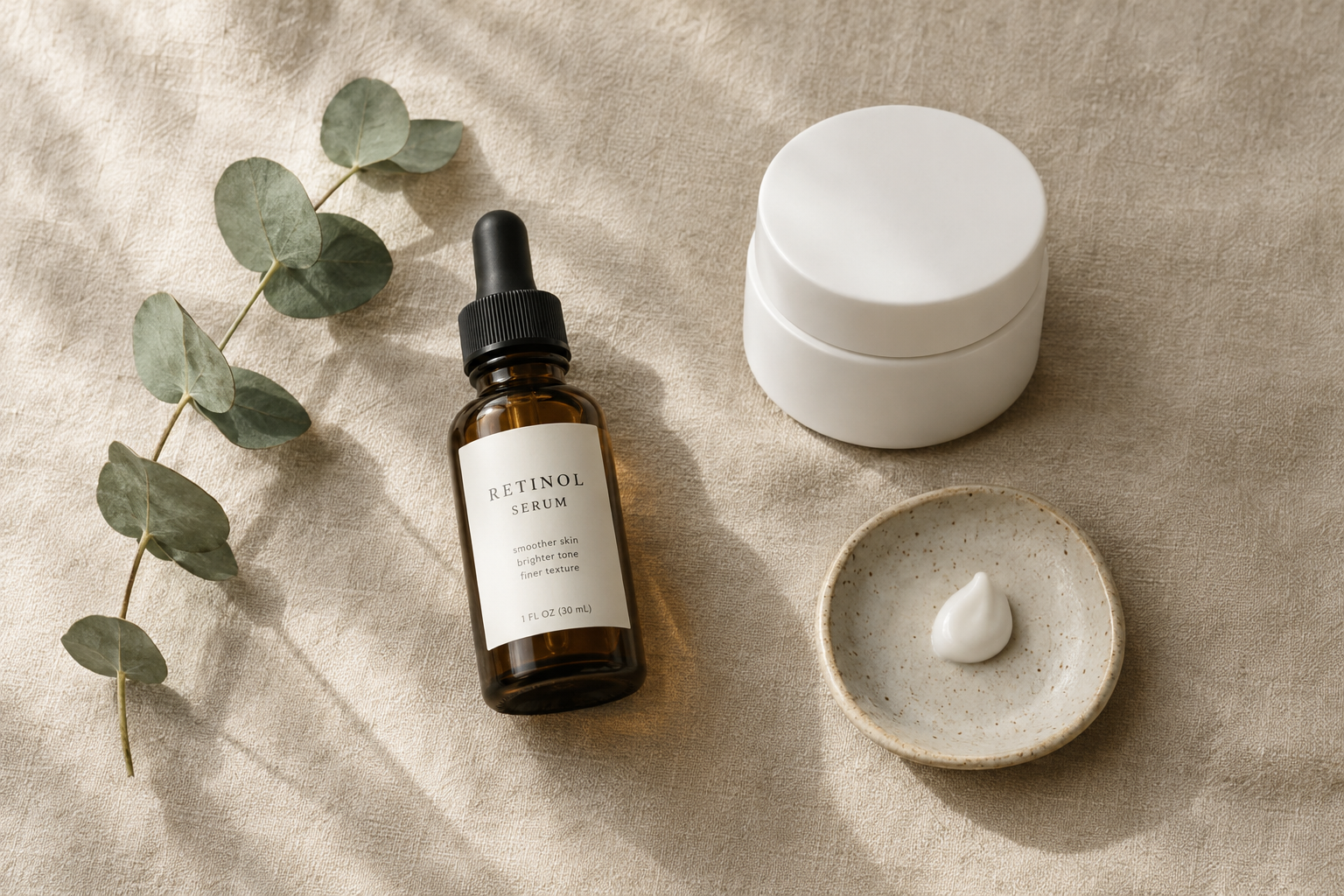
Thinking About a Retinoid? A Beginner's Guide to Starting Gently
If you have spent any time reading about skincare, you have almost certainly seen the word “retinoid” — on packaging, in articles, and in every list of “holy grail” ingredients. Retinoids are vitamin A–derived ingredients widely studied for their effects on skin texture and appearance. They can be a wonderful addition to a routine, but they are also one of the most commonly misused ingredients, often abandoned after a rough first few weeks.
This guide is simply about starting well: what retinoids are, how to introduce one gently, and what to expect in the first months. It is general education, not personal medical advice — your dermatologist or healthcare provider is the right person to advise on your specific skin.
What Is a Retinoid?
“Retinoid” is an umbrella term for vitamin A–derived compounds. The range includes prescription options such as tretinoin, as well as over-the-counter retinol and retinyl esters, which are typically gentler and work more gradually. All of them share the same general idea: they influence how skin cells renew and behave over time, which is why they are associated with smoother-looking texture and a more even appearance with consistent use.
Why “Go Low and Slow” Matters
The most common beginner mistake is using a retinoid too often, too soon. Skin needs time to adjust, and pushing through with frequent applications often leads to dryness, redness, flaking, and irritation — the very things that make people quit. Dermatologists, including the American Academy of Dermatology, generally recommend starting with a low strength and using it infrequently at first, then building up gradually as your skin tolerates it.
A Gentle Starter Plan
There is no single correct schedule, but a commonly suggested beginner approach:
- Start small and infrequent. Apply a pea-sized amount to dry skin, perhaps one or two evenings a week, for the first few weeks.
- Moisturize generously. Many people apply moisturizer first (the “sandwich” approach) or after the retinoid to buffer the experience and support the skin barrier.
- Ramp up gradually. If your skin stays comfortable, slowly increase frequency over several weeks. If irritation appears, step back down.
- Use sunscreen every morning. Retinoids can increase sun sensitivity, and daily broad-spectrum SPF is one of the most important habits for skin health in any routine.
- Keep the rest of the routine simple. A gentle cleanser, a bland moisturizer, and SPF pair well; strong exfoliating acids in the same session can add up to irritation.
Common Beginner Questions
“I’m flaking — should I stop?” Some dryness and flaking is common early on. Often the answer is not to quit, but to slow down: reduce frequency, increase moisturizer, and let your skin settle. Persistent or significant irritation is a reason to pause and check in with a professional.
“Can I use it during pregnancy?” Many topical retinoids are generally not recommended during pregnancy or while breastfeeding. This is an important conversation to have with your healthcare provider before starting any retinoid.
“How long until I see anything?” Retinoids work slowly — typically over months of consistent use, not days or weeks. Timelines vary from person to person.
Practical Takeaways
- Choose a low strength to begin with and let your skin adjust.
- One or two nights a week at first; increase gradually.
- Moisturizer is your ally.
- Daily sunscreen matters more than any single product.
- Skip strong acids on the same nights when starting out.
- When in doubt — especially with pregnancy, sensitive skin, or ongoing conditions — ask a dermatologist or qualified professional first.
A Gentle Closing Thought
Retinoids have a reputation for being intimidating, but most of the difficulty comes from starting too fast. A patient, low-and-slow introduction — paired with moisturizer, sunscreen, and realistic expectations — makes the experience far more comfortable. If you would like help choosing a starting point for your skin, a conversation with a skincare professional is a great first step.